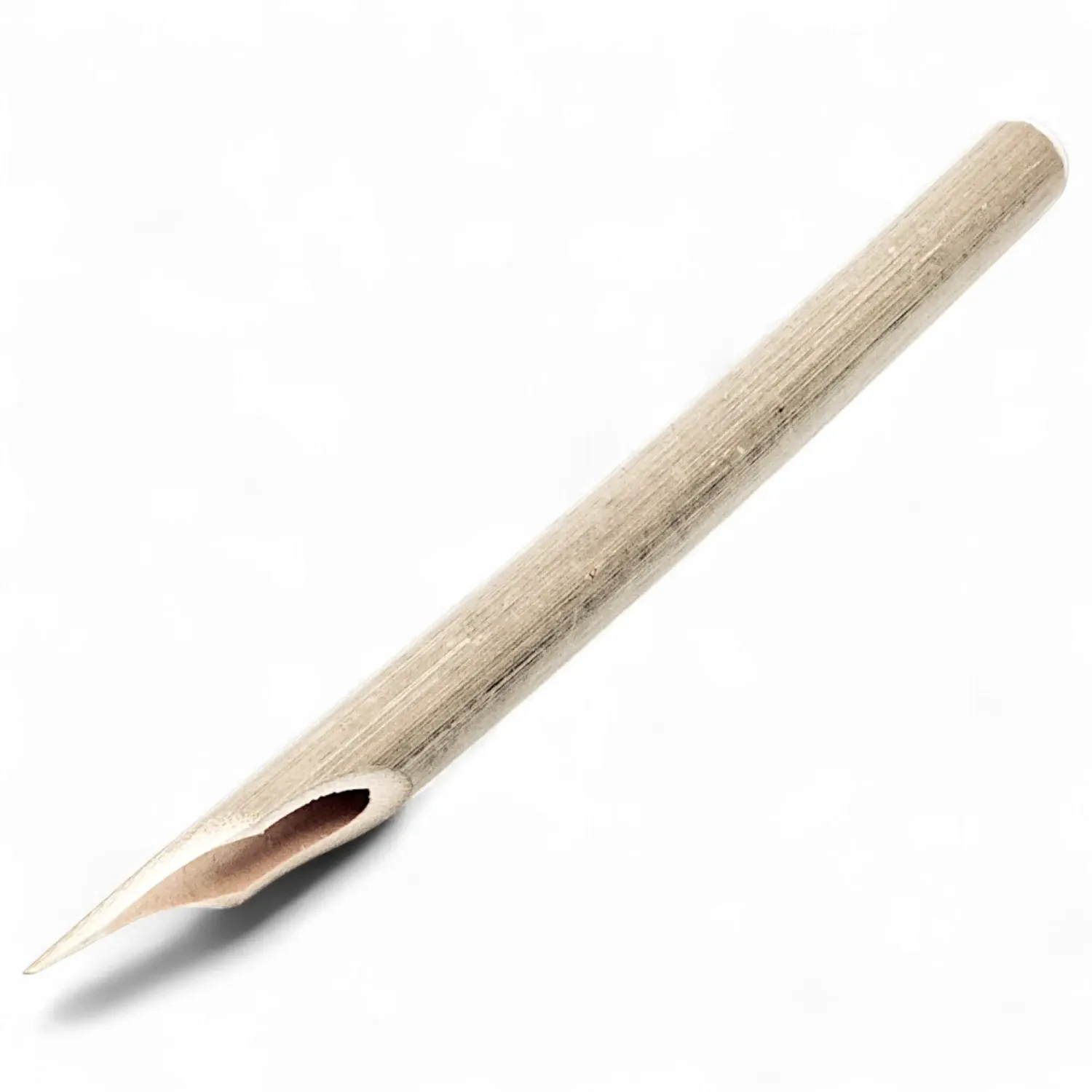
Medieval writing quills (penna scriptoria): natural quills for authentic calligraphy
Quick explanation
The penna scriptoria is a natural, cleaned goose quill that has been used as a writing instrument on parchment and papyrus since late antiquity (4th to 7th century AD). This set contains 10 uncut white goose quills, each approximately 25 cm long, along with illustrated cutting instructions. It is suitable for calligraphy, living history and history lessons from lower secondary level onwards.
When did the goose quill replace the reed calamus as a writing implement?
The transition from reed to bird quill took place between the 4th and 7th centuries AD in the Latin West. The first clear written source is provided by Isidore of Seville (c. 560–636 AD) in his *Etymologiae*, Book VI, Chapter 14. There he explicitly mentions calamus (reed) and penna (bird’s feather) side by side as writing implements. The quill pen is then iconographically attested in the Carolingian portraits of the Evangelists, for example in the Ebbo Gospel (c. 820 to 835 AD, Bibliothèque municipale d’Épernay, Ms. 1).
A common misconception regarding Rome and the quill
Many people automatically associate “Roman scribes” with the goose quill. This is historically incorrect. In the early and middle Imperial periods (1st to 3rd centuries AD), people wrote on papyrus and parchment almost exclusively with the calamus, a reed cut at an angle. This is evidenced by original reed styluses from the British fort of Vindolanda (1st to 2nd centuries AD, now in the British Museum, London) and by Pompeian wall paintings such as the double portrait of the so-called Paquius Proculus (Naples, Museo Archeologico Nazionale, Inv. 9058,
1st century AD). In this painting, the woman is clearly holding a calamus, not a goose quill.
Why did the penna become the norm in the Middle Ages?
From the 4th century AD onwards, parchment replaced papyrus north of the Alps and became the dominant writing material in monastic scriptoria. Its rough, slightly greasy surface required a flexible, sharp writing implement with its own ink reservoir. The hollow goose quill with a split tip provided both. Geese were available all year round , with the fifth and sixth flight feathers from the left wing being particularly suitable for right-handers. From the Carolingian Renaissance until the advent of printing around 1450 AD, the penna remained the standard instrument of the European scribe.
-
Nib length: approx. 25 cm per piece
-
Material: White goose quill (penna anserina), natural and cleaned
-
Set contents: 10 pieces, uncut
-
Date of form: Established 4th to 7th century AD (Isidore, Etym. VI,14)
-
Reference example: Ebbo Gospel Book (c. 820–835 AD, Épernay, Ms. 1)
How does the goose quill work in workshops and classrooms?
We have been using this quill pen set regularly since 2022 in museum education projects for lower secondary school pupils, most recently in spring 2025 during a monastery project week at a secondary school in Hesse. The observation remains consistent: Year 6 pupils need around ten minutes to produce their first usable stroke and subsequently write more calmly and with greater concentration than when using a modern fountain pen. The trimming process itself is the real learning experience, as it trains both patience and fine motor skills.
Two practical techniques proved particularly effective in 2025 and 2026. Firstly, hardening: place the nib in hot sand (approx. 60 to 80 °C) for about 30 seconds before cutting; this makes the quill cut-resistant.
Secondly, use flat glass marbles as inkwells; this prevents them from tipping over.
Our specific advice for teachers is:
Allow a full double lesson for the introduction, hardening and first attempt at writing, and provide two quills per pupil. The second quill serves as a spare in case the first cut fails.
Why is the set of 10 uncut goose quills worth it?
Uncut quills give you full control over the nib width, gap and writing angle. The set is specifically designed for beginners and advanced calligraphers. Three clear decision-making aids:
- If you are planning a project week on the Middle Ages or Late Antiquity, 10 quills are sufficient for a whole class with a reserve.
- If you are working on historical re-enactments for periods from the 5th century AD onwards, the natural quill provides an authentic prop without any traces of modern processing.
- &If you are practising calligraphy with iron gall ink, this set is particularly worthwhile because you can try out several nib shapes (pointed nib, broad nib) on the same blank.
For primary school projects involving children under 10, or for Egypt-themed project weeks where the calamus is an essential teaching aid, we recommend a reed or a pre-cut model instead.
Frequently asked questions about the penna scriptoria quill
How long does a single goose quill last with regular use?
A well-hardened goose quill lasts for about one to two weeks with daily use before the tip needs to be re-sharpened.
According to palaeographic research, medieval scribes used several nibs per working day. By re-sharpening it several times, a nib can be reused ten to fifteen times until the shaft becomes too short.
Why did many calligraphers harden the quill before trimming it?
A fresh goose quill is moist on the inside and soft on the outside, which causes the tip to fray. By placing it in hot sand for 30 seconds (approx. 60 to 80 °C C), any residual moisture evaporates and the keratin hardens. The tip can then be split cleanly and retains its writing edge for significantly longer.
What is the difference between goose quill (penna) and reed (calamus) in terms of writing feel?
The calamus, made from reed, feels stiffer in the hand and produces a firm, even stroke, typical of everyday Roman script from the 1st to the 3rd century AD. The goose quill, on the other hand, is elastic, springs back when pressed and allows for finer, more varied strokes. This is why it became the standard with the rise of parchment in the Middle Ages.
Can left-handers use the penna scriptoria?
Yes, although ideally a quill from the right wing should be chosen, as it curves more naturally for the left hand. The quills supplied are not sorted by wing side; for most applications and &
beginners, the standard shape is sufficient. Re-enactment specialists opt for specifically sorted left-handed feathers.
Can the natural quills be dyed or decorated afterwards?
Yes, the upper quill section can be coloured with watercolour or diluted ink without impairing its writing function. Historically, however, there is no evidence of painted ceremonial quills; medieval scribes used plain, cleaned quills. For stage props and children’s workshops, colouring is a popular and straightforward addition.
Sources and further reading
-
Wikipedia on quill pens: Quill pen – history, manufacture and use
-
Archaeological comparative context: Vindolanda writing implements and ink tablets at the British Museum, London (Evidence for the calamus as a Roman writing implement, 1st to 2nd century AD)
-
Bernhard Bischoff: Palaeography of Roman Antiquity and the Western Middle Ages. Erich Schmidt Verlag, Berlin 1979 (4th edition 2009). Standard work on the development of Latin writing implements and writing cultures. Reference to Zenon DAI.
-
Michelle P. Brown: A Guide to Western Historical Scripts from Antiquity to 1600. British Library, London 1990. An introductory handbook with illustrations of Carolingian scribes and quills.
-
Isidore of Seville: Etymologiae, Book VI, Chapter 14 (c. 625 AD). Earliest clear distinction between calamus and penna as writing implements.
Updated on: 18/04/2026