Fibulae

What the Brooch Reveals About Its Wearer

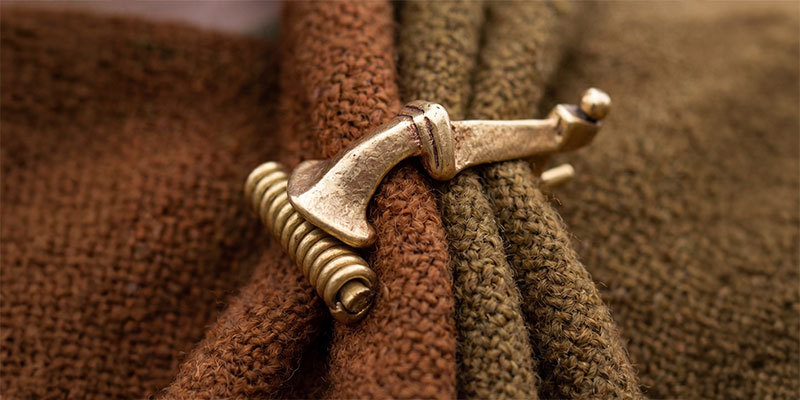
A fibula is the metal garment brooch of antiquity, serving both as a fastening device and a status symbol. It held the cloak together and at the same time revealed the rank, origin, and period of its wearer. An Aucissa fibula identifies early imperial dress, while an omega ring fibula is frequently found among provincial Romans and Germanic peoples. Tacitus documents the fibula as the standard fastening used by Germanic men. Modern research classifies the forms according to Almgren, Ettlinger, and Riha.

  • Range of types: from hinged bow fibulae to crossbow fibulae with onion-shaped knobs
  • Historically appropriate materials: bronze, iron, and silvering, historically documented materials
  • Clear dating: every form clearly assigned to a specific period
  • Functional: all pieces fasten with a real pin

Anyone who wants to refine their portrayal should choose not just any fibula, but the type that is historically appropriate.
Antike Replikate und Bastelspaß in der Schule | Der Römer Shop


Items 1 - 13 of 13

Over 64.368 customers worldwide since 2001

Museums, schools and historical enthusiasts throughout Europe trust the products from Roman Shop.

Customer testimonials

 Eine Bewertung von Archäologischer Park Carnuntum
Archäologischer Park Carnuntum Austria

Young Roman friends can immerse themselves in the Roman past with numerous activities. Products from the Römer Shop are regularly and successfully used at this great event. Year after year, children of all ages can write on wax tablets and get to know real papyrus.

 Eine Bewertung von Scriptorium
Scriptorium Germany

The everyday equipment with glasses and ceramics is also really well made and has survived the hard life of a soldier well. In general, the range of products is truly sensational and offers unique products from the Roman era for many age groups and requirements, from hardcore legionnaires to little Roman fans of primary school age.

 Eine Bewertung von Dominikaner Museum
Dominikaner Museum Rottweil -Germany
Satisfied customers

The Dominikanermuseum Rottweil presents in its department "Roman Rottweil - Arae Flaviae" the life in the only Roman city in Baden-Wuerttemberg. We have been a customer of Römershop for a long time for our own museum shop and are convinced of the high and, above all, consistently high quality of the products. The entire team is always looking forward to new products and our shop is an attraction for our visitors thanks to good replicas.

 Eine Bewertung von Mathias S.
Mathias S. Deutschland

Hallo, ich wollte nur kurz ein feedback zur Lieferung geben; Also der „Asklepios“ ist wirklich großartig. Authentische Replik, unschlagbarer Preis. Vielen Dank dafür. Verpackung war auch vorbildlich.
Viele Grüße Matthias Semmler

 Eine Bewertung von Gemeinschaftsschule M. F.
Gemeinschaftsschule M. F. Mölln

Hello and thank you very much for the great products!

Our students were thrilled with the papyrus coloring pictures and the scarabs. As promised, I am sending you photos of the work with the coloring pictures. I wrote a review for the "scarab" coloring picture, but it can also be added to all the other pictures, since we had different motifs.

 Eine Bewertung von Centurio Markus N.
Centurio Markus N. Germany

The lovingly and authentically designed products from the Römer-Shop have been accompanying me for years and even decades in the field of ancient representation. As a centurion in a Roman military unit until a few years ago, the stationery, from wax tablets to papyrus scrolls, was extremely helpful for high-quality appearances and presentations at museum festivals, in reenactment and in museum education work.

 Eine Bewertung von Remo S.
Remo S. Schweiz

Salve Manuela, Im Anhang findest du den Lar und was ich aus ihm gemacht habe. Ich bin sehr zufrieden mit der Figur.
Cvra, vt valeas Remo

 Eine Bewertung von Dr. Reinhard S.
Dr. Reinhard S. Deutschland

Sehr geehrtes Römer-Shop Team, wie immer:
--schnelle und prompte Lieferung
--qualitativ hochwertige Ware
--volle Identität mit der Abbildung der Produkte
--sehr gutes Preis-Leistungsverhältnis
--umfassendes Angebot Vielen Dank. Weiter so. Salvete Reinhard

 Eine Bewertung von Torsten B.
Torsten B. Deutschland

SALVE , Manuela und Andreas mit Team,
ich möchte meine Bewertung in Reimform darbringen:
Die Trinkgefäße und der Wein, sollten ein Geschenk für meine Eltern sein. Was soll ich sagen-Ihr lieben Leut, es hat beide sehr erfreut!
Sonnige Grüße Torsten

 Eine Bewertung von Papa Ralf & Sohn
Papa Ralf & Sohn Germany

The card is easy to work with and the cardboard is sturdy enough for such projects. Perhaps small cast figures and horses on a plastic base would be a useful addition to the shop, rather than the cardboard pictures. My 12-year-old son had fun making something like that

 Eine Bewertung von Centurio Zoltan
Centurio Zoltan Hungary

Dear Manuela and Andreas!

Thank you very much for everything and your help. The package arrived here safe and sound and complete. I am very, very satisfied with every product and I really like every item. Since I am constantly expanding my Roman collection, I would like to buy from you in the future if possible Thank you again for everything and see you next time.
Kind regards from Hungary: Zoltan

 Eine Bewertung von Norbert H.
Norbert H. Germany

Here is one of the results of your mosaic stones. The Beyenburg coat of arms, 70 x 70 cm.
Regards
Norbert

Six centuries of fashion, cast in bronze

Roman brooches of various types, from Aucissa to crossbow brooch | Der Römer Shop

Who wore what – and how it could be recognized

Could a Roman tell from the cloak clasp of the person opposite him who he was dealing with? In many cases, yes. The brooch was not merely a fastener – it was a loud label. An Aucissa brooch identified the early Imperial soldier or civilian between 30 BC and AD 80. It can be recognized by its hinge, which replaced the older spring mechanism. A Noric-Pannonian wing brooch belonged to the 1st century AD and to the shoulders of provincial women from Noricum or Pannonia. It was often worn in pairs and connected by a small chain.
Among the Germanic peoples, meanwhile, a brooch fastened the sagum; the makeshift alternative was a thorn (Tacitus, Germania 17.1). Anyone who saw a brooch also read region, gender, and an approximate time period from it.

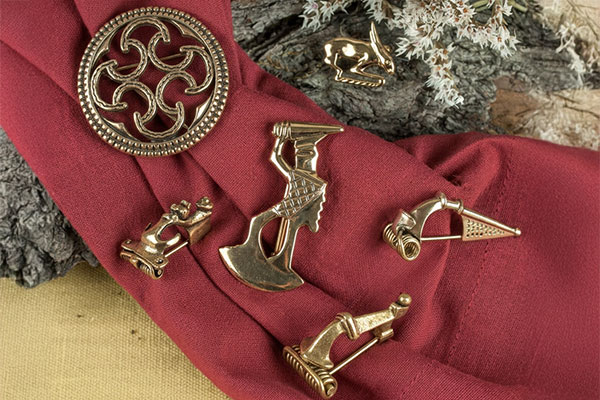
The animal and disc brooches of the 2nd and 3rd centuries AD are especially informative. Hare, bird, and horse brooches are among the most common figural forms of the middle Imperial period. They served primarily as women’s jewellery, often with colourful enamel inlays in red, blue, and green. The disc brooch with four peltae – the pelta-shaped shield motif originated in the eastern Mediterranean – belongs to the same fashion wave. Finds from the north-western provinces, for example from Augst, Mainz, or the Rhineland, document their wide distribution.

The Fibula as an Ancient Service Badge


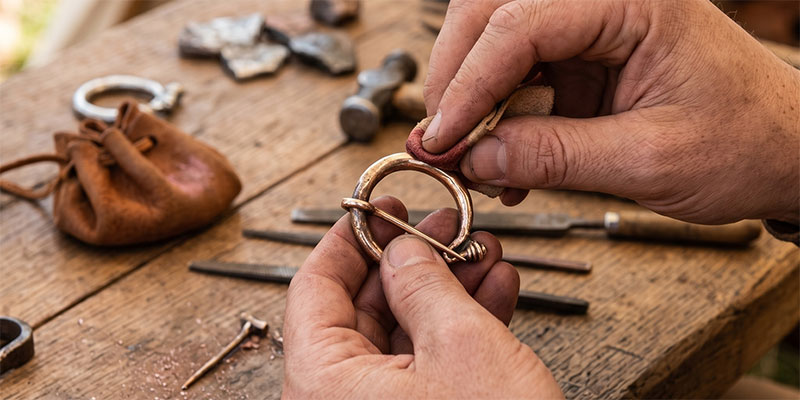
In everyday reenactment, the fibula proves to be the most frequently used piece of jewellery. It fastens the cloak on the shoulder, holds the mantle across the chest, and secures the folded cloth to the tunic. A type-accurate, functional fibula is therefore the basic investment for every serious portrayal of the Roman world.

  • Functional principle: classic bow-spiral-pin mechanism, faithfully based on original finds
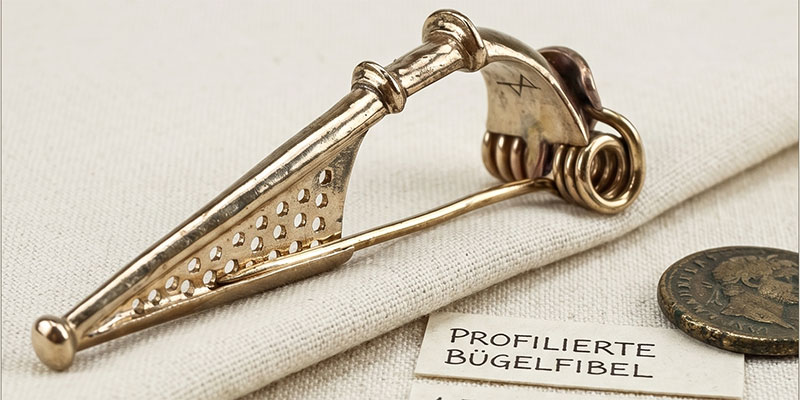
  • Clear typology: Aucissa, Norico-Pannonian, omega, crossbow, disc, and profiled forms
  • Material authenticity: bronze as the historical standard material, supplemented by iron and silver plating
  • Precise dating: each form assigned to a specific period, with no vague, timeless version of antiquity

The crossbow fibula was, in the 4th century, roughly what a company ID badge on a jacket is today. Whoever wore it signalled affiliation with a military or civil administration without saying a word. The Aucissa fibula, by contrast, functioned like a chronological fashion label: present everywhere during the first seventy years of the Imperial period, then gone. After eighty years, it was as out of fashion as a particular sneaker shape after ten years. This discipline of dating is exactly what makes a serious portrayal convincing.

A type-accurate fibula makes all the difference in a portrayal.

Antike Replikate und Bastelspaß in der Schule | Der Römer Shop

Do you need just one fibula, or rather several?


Perhaps you are just starting out in reenactment and need your first securely dated fibula: in that case, the profiled bow fibula is a robust entry-level choice, clearly visible, firmly placed in the 1st century AD, and in the mid-range price segment. Perhaps you have already been portraying historical characters for years and want to complete your collection: then it is worth deliberately building up a typological series, from the Aucissa-related hinged fibula to the Norico-Pannonian form and finally the crossbow fibula. Perhaps you present several periods in one season, for example the early Imperial period at one event and Late Antiquity at another: then two or three typical fibulae from the range are the simplest tool for changing your portrayal without replacing the entire outfit. Perhaps you work in museum education or school teaching: then a small set of different types makes the change in fashion over six centuries tangible, from the 1st to the 5th century AD.


An investment that grows with your portrayal

Unlike a tunic or shoes, a fibula is not a wear-and-tear item. A bronze fibula will withstand decades of active use in reenactment, provided that the spiral wire or hinge is occasionally readjusted. This makes it the most sustainable investment in the entire outfit. A second fibula may be added a few years later, a third at some point after that – and eventually you have a small typological series that can be displayed as a whole. Teachers and museum educators use exactly this effect for display-case presentations that require no additional equipment.


One fibula is enough to begin with; three are enough for every period.

Your advantages

Forum Traiani trademark

Our registered own brand that stands for local and social production

20 years of experience

Large archäological network and collaboration with schools and museums.

Buying on account
Buying on account

For schools, authorities and private customers (Paypal service)

Sustainable packaging

We recycle our suppliers' cardboard packaging and give every cardboard box a second life.

General questions

You will find the most important answers in the FAQs. Can't find your answer? No problem: write to us!

Questions about our store?

How fast is the shiping?
Can I also order on account?
Do we support X-Invoices and Route IDs?
Does the Roman Shop also supply to traders and museums?
Returns
Andreas und Manu vom Römer Shop

From Glauberg to Hollywood...

Our boundless passion for antiquity

We believe that history is not only to be found in books or museums, but that it is should be brought to life and experienced across all borders.

By offering Roman replicas and other antique products, we want to bring this bring this fascinating time to life and give people around the world the opportunity to put themselves themselves into it.

Our products help to ensure that history is not just a collection of facts but becomes an eventful and unforgettable adventure.

Produced, assembled, picked, packed and on its way. This is how our products from Glauberg on their journey to your home. Into the classrooms of your children, the shelves of museum stores to the big movie sets in Hollywood...!

With the Römer Shop you can...
Touch, see, smell and experience history.


About us and how it all began
Insta Romanum
Insta Romanum

Experience history visually –
Veni, vidi, click! I came, I saw, I followed.

Roman encyclopaedia
Roman encyclopaedia

Background information, tips and facts about ancient Rome. Ancient knowledge simply explained!

An empire worth exploring

History, craft ideas and Roman knowledge in HD instead of wax tablets. Get the popcorn ready and put on your tunics!

Forum Romanum 2.0
Forum Romanum 2.0

Like, post, follow – just like the Romans in the Senate! Here, history isn't just told – it's shared.