Making Papyrus in the Classroom
The Most Important Points at a Glance
This article shows, in a sensitive and engaging way, how working with papyrus in the classroom can lead from a simple comparison of materials to deep historical understanding. Through careful observation, thorough analysis, and hands-on experimentation, students uncover the ancient production principle and understand why the cross-layered structure was technically so effective.
It becomes clear that papyrus is not just a simple craft idea, but the material foundation of administration, trade, and state organization. The project combines sensory learning with an understanding of systems and makes it tangible how important writing materials were for the functioning of entire empires.
Table of Contents
The Rustling of Power
Introduction in the Classroom – A Material That Raises Questions
Deepening Understanding – The Production Principle as a Model Experiment
Pedagogical Reflection – Why Making Papyrus Yourself Works
Closing Image – The Quiet Rustling of Civilization
FAQ on Production
Sources
The Rustling of Power
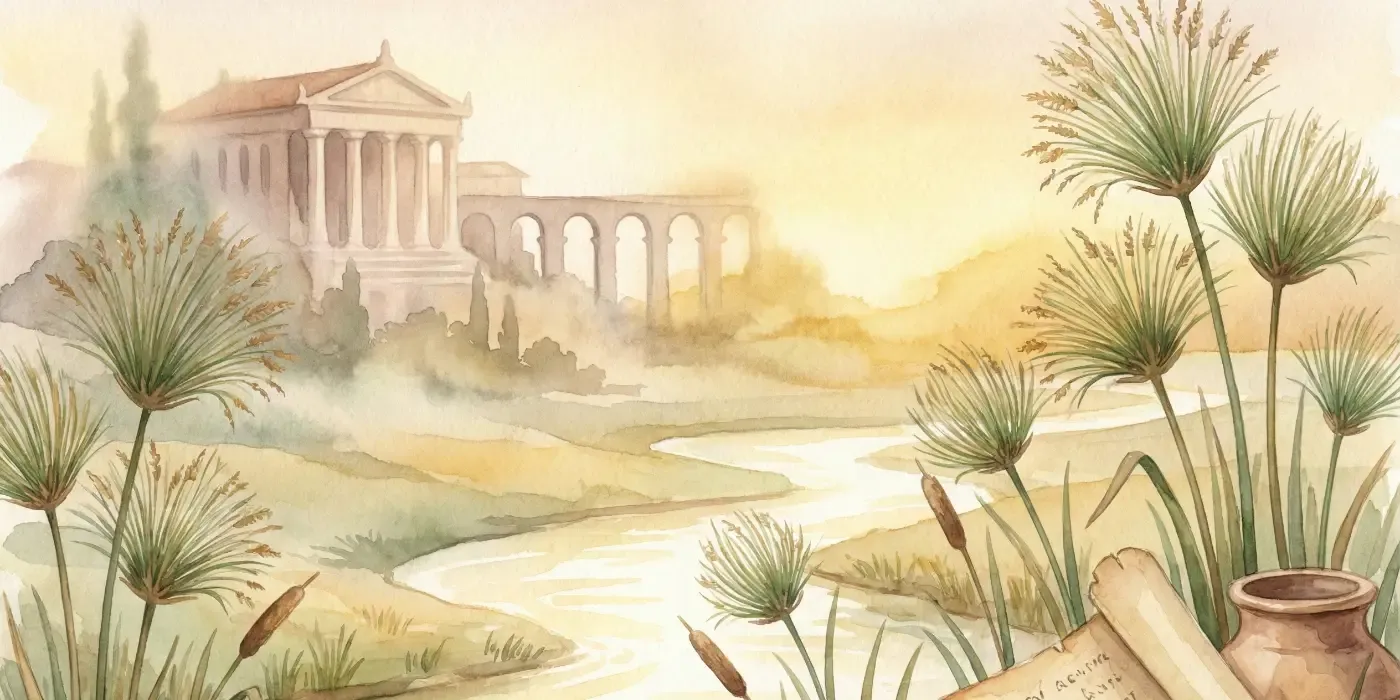
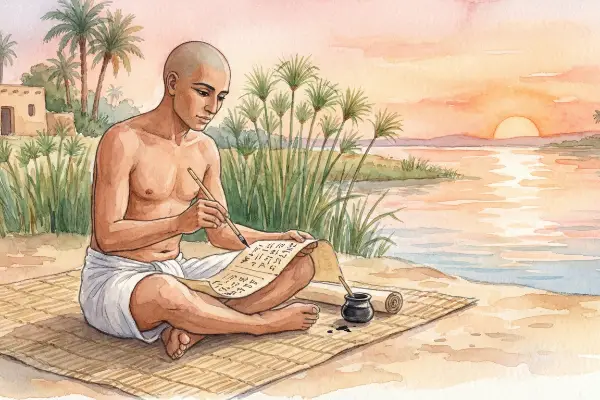
It is early morning on the Nile. The air is fresh and clear, and the water carries the scent of plants and mud. There sits a scribe, cross-legged on the ground, holding a rolled papyrus scroll in his hands, carefully tied and prepared. He dips his reed pen into black ink and begins. Every stroke is precise and full of dedication. Every single name matters. Every number has its own meaning: tax, property, responsibility.
What is taking shape here is something extraordinary, something difficult to capture in words. It is administration. And administration is power.
And yet our word “paper” comes from this very material. In our language, we still carry the memory of a technique older than almost everything we take for granted in the classroom.
In ancient Egypt, papyrus was not merely a cultural object. It was infrastructure. Without papyrus, no tax lists. Without tax lists, no grain stores. Without grain stores, the kingdom cannot function. Writing was not a luxury. It was the heart and soul of the land.
So when students hold a piece of papyrus in their hands today, they are not simply holding a historical craft material. They are holding a medium that made administration possible, structured trade, and supported military organization. They are touching the material on which empires calculated, planned, and controlled.
And this is exactly where the lesson begins.
And right here there is something that is difficult to explain fully in words: it happens through the sound papyrus makes. When you hear that dry, slightly brittle rustling, it feels as though you are discovering a completely different kind of paper, one that sounds nothing like modern paper.
At this point, the key question is no longer “What is papyrus?” It is “What changes when an empire is able to write?”
In that moment, a material becomes a key to understanding power and organization. An inconspicuous plant becomes a tool of political order.
We set off on a small journey through time, one that begins not in the mind, but in the hands.
A phase of teaching in which history is not explained, but experienced.
Introduction in the Classroom – A Material That Raises Questions
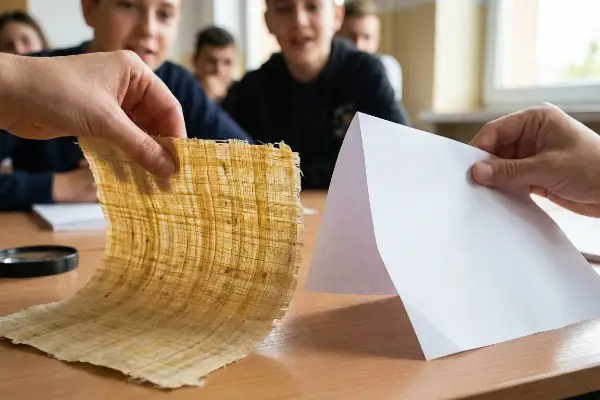
Imagine this moment. You place two materials on the table. On the right, an ordinary sheet of copy paper. On the left, a piece of papyrus. No explanation. No heading. Just one instruction: “Pick it up and feel it!”
And suddenly the room becomes quieter.
Modern paper is smooth, flexible, and familiar. It folds neatly and springs back slightly. It smells like nothing. It feels industrial, even if no one would put it that way.
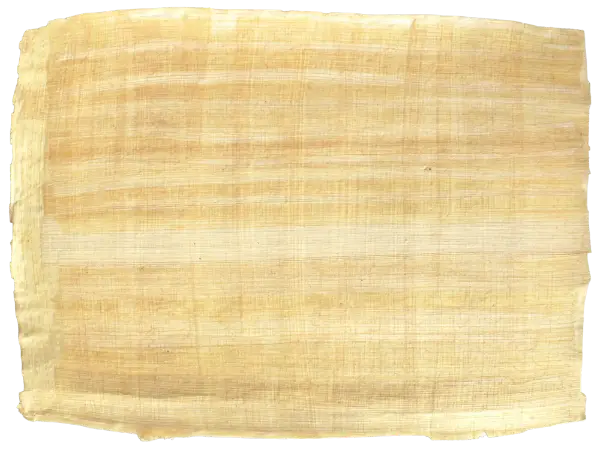
The piece of papyrus, by contrast, offers resistance. It is firmer and slightly more brittle. Its surface shows fine, intersecting strips. You can not only see the structure, but feel it as well. It seems more organic, almost alive. When you bend it slightly, you immediately notice that the fibers are working.
This is exactly where the lesson begins. Not with an explanation, but with a moment of productive confusion.
The guiding question is: “Why does this feel so different?”
Even before the goal of “making papyrus yourself” is mentioned, curiosity arises. Students observe. They compare. They form hypotheses. Is it woven? Is it glued? Does it grow like this? Why do the lines run across each other?
At this point, a guided observation phase is worthwhile.
- What differences do you notice?
- How do the materials react when you fold or tear them?
- Is there a preferred fiber direction?
From a technical point of view, papyrus is not made of ground plant fibers like modern paper. Modern paper is made from pulp. For this, wood is chemically or mechanically processed, the fibers are suspended in water, and then matted together into a homogeneous sheet.
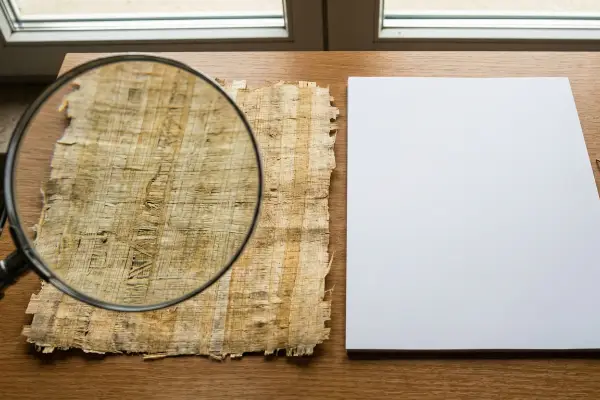
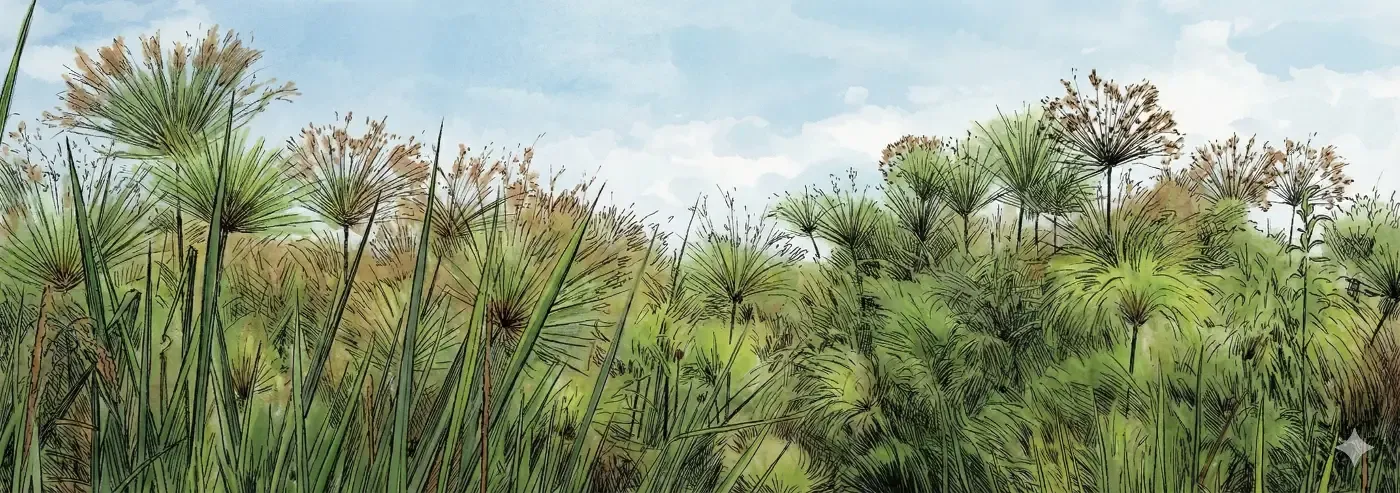
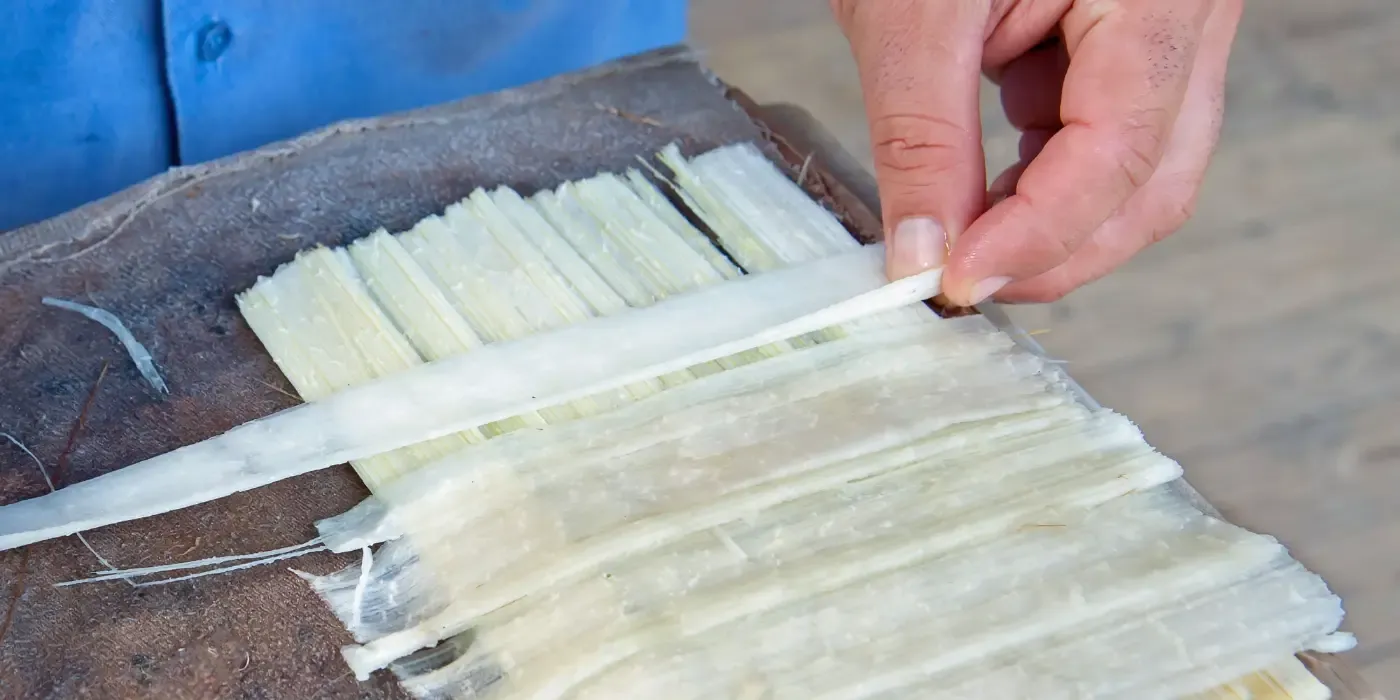
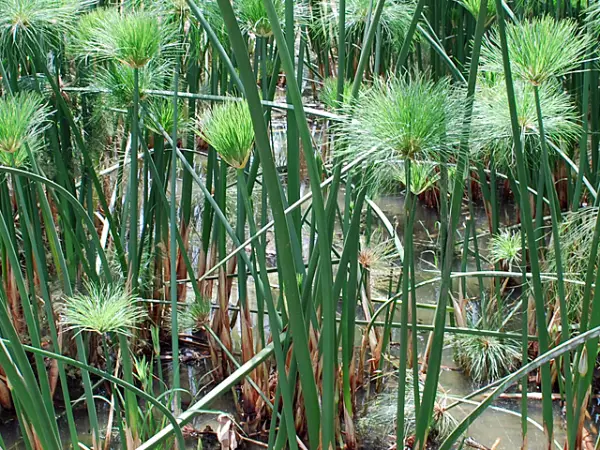
Papyrus works in a fundamentally different way. Here, the pith tissue of the plant Cyperus papyrus is cut into strips. These strips are laid next to one another. A second layer is then placed across them. Under pressure and through the plant’s natural sap, the layers bond permanently. This creates a fiber-reinforced plant laminate.
It is precisely this cross-structure that students can recognize with the naked eye.
Now comes the crucial pedagogical step. You turn the question around.
If papyrus is constructed this way, couldn’t we make it ourselves as well?
At this point, the focus emerges naturally. “Making papyrus yourself” is not presented as a craft project, but as the logical consequence of observation. Anyone who understands that the material consists of crossed strips immediately realizes that the production principle can be reconstructed.
That is the moment when paper stops being a consumable and becomes an experiment.
A small fun fact reinforces the effect. Although our word “paper” comes from “papyrus,” the two are technically completely different materials. Linguistically related, technologically separate. In our experience, this regularly leads to astonished faces.
And there is one more thought worth leaving in the room: for centuries, papyrus was an Egyptian export product throughout the ancient Mediterranean. Anyone who wanted to write depended on a plant that grew along the Nile. Already here it becomes clear that the history of materials is always also economic history.
So this material-based introduction accomplishes three things at once.
- It activates the senses.
- It creates genuine questions.
- And it opens the door to a practical project in which making papyrus yourself is not a gimmick, but historical understanding through reconstruction.
At this moment, history does not begin in the textbook. It begins between two layers of plant fibers.
Deepening Understanding – The Production Principle as a Model Experiment
Now it becomes practical.
From the question comes an experiment.
From observation comes reconstruction.
If the goal is to make papyrus yourself, then it is not about producing a decorative result. Rather, it is about making an ancient production principle understandable. And that is exactly where the strength of this teaching step lies.
First, the principle is stated clearly. Papyrus is not created by grinding and reforming fibers. It is created by layering and crossing strips. This simple yet ingenious process is the key.
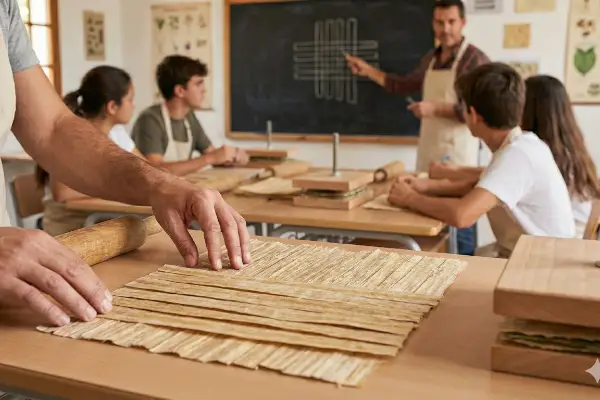
In the model experiment, narrow strips are therefore prepared first. Ideally, these consist of a suitable material such as real papyrus strips or, for example, thin plant strips or moistened paper that simulates the fiber structure. What matters is not botanical exactness, but the structural principle.
Step one: The strips are laid closely side by side in one direction.
Step two: A second layer is placed across them, always with slight overlap.
Step three: The whole arrangement is then pressed and weighted down.
Step four: Drying under pressure, with the cloths changed several times.
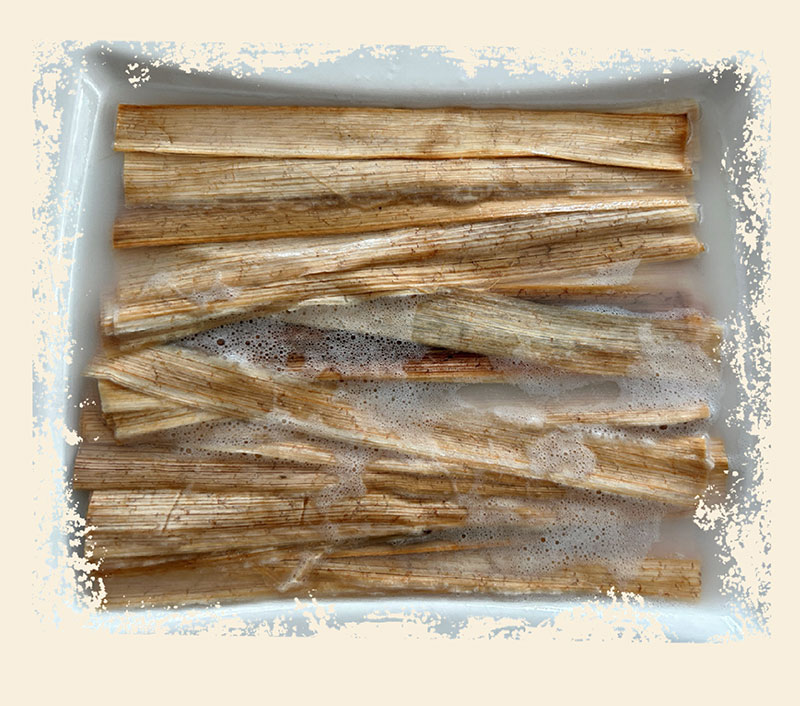
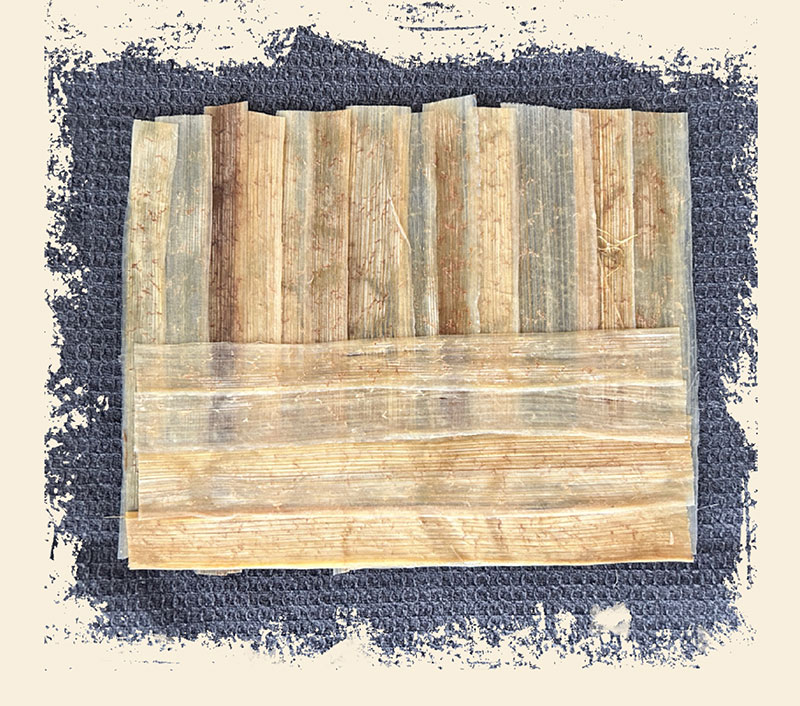
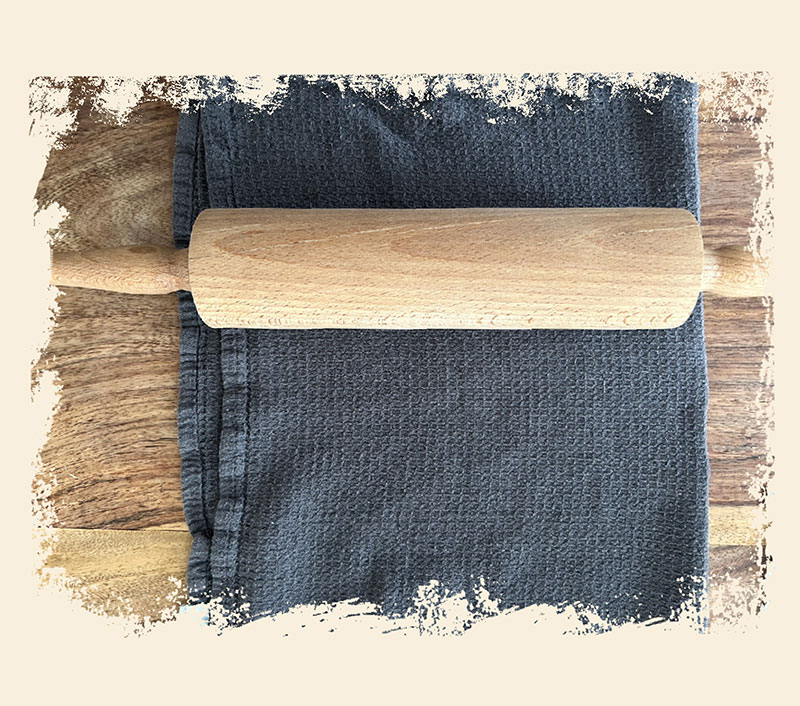
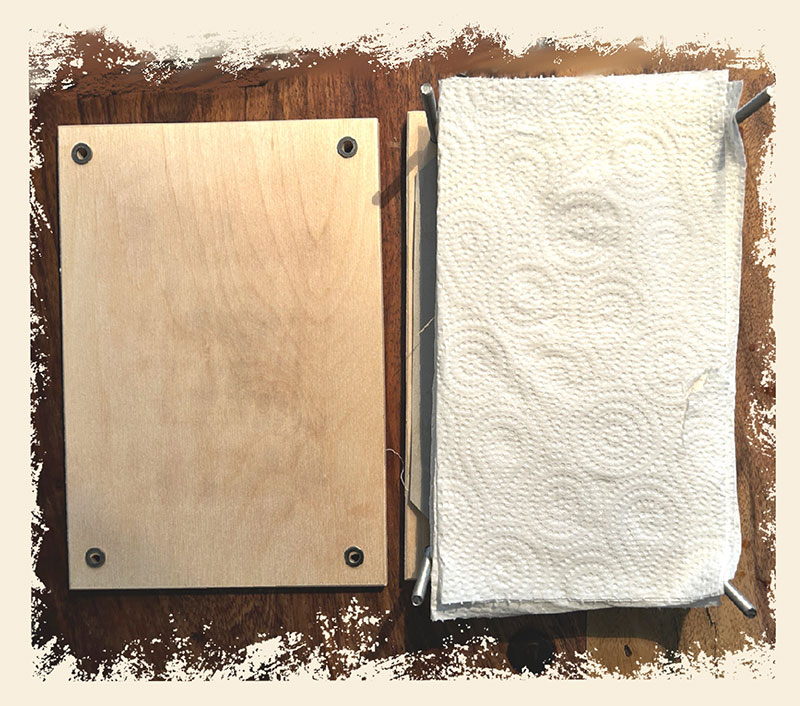
At this stage, it is worth incorporating the scientific explanation. In the historical model, strips were cut from the pith of the plant Cyperus papyrus. This pith contains pectins and plant juices that act like a natural adhesive under pressure. Through pressing, the fibers interlock mechanically and chemically. In this way, a stable, coherent writing surface is created.
The decisive factor is the cross-structure. It gives the material stability in two directions. Students immediately recognize that technology often consists of simple but well-designed solutions. No complex machines. No chemical process. Just pressure, structure, and plant tissue.
This is exactly where the project “making papyrus yourself” unfolds its didactic value.
You do not only understand how it was made.
You also understand why it was made that way.
An exciting point of observation during drying is the change in the surface. The strips visibly bond together. The transitions become more homogeneous. At the same time, the crossing of the fibers remains visible. Later, this pattern is not only visually interesting, but also functionally important.
Historically, people preferred to write along the fiber direction of the upper layer, that is, along the horizontal fibers. This reduced resistance when writing with a reed pen. The side on which the fibers ran horizontally was generally regarded as the main side. In technical terminology, the front is called the “recto” and the back the “verso.”
Another often overlooked aspect is that papyrus sheets were glued together into scrolls that could be several meters long. The format was therefore not chosen at random. It was designed for continuous writing. Administration thought in scrolls, not in individual pages.
When students hold their dried test piece in their hands, they realize that they have not simply made a craft object, but created something highly practical. They have solved a technical problem that was of decisive importance more than three thousand years ago. How can a stable, writable surface be made from a plant?
Making papyrus yourself thus becomes a small-scale reconstruction of ancient engineering.
And this is exactly the moment when the perspective shifts.
Papyrus is no longer an exotic relic.
It is the result of a well-conceived material strategy.
Pedagogical Reflection – Why Making Papyrus Yourself Works
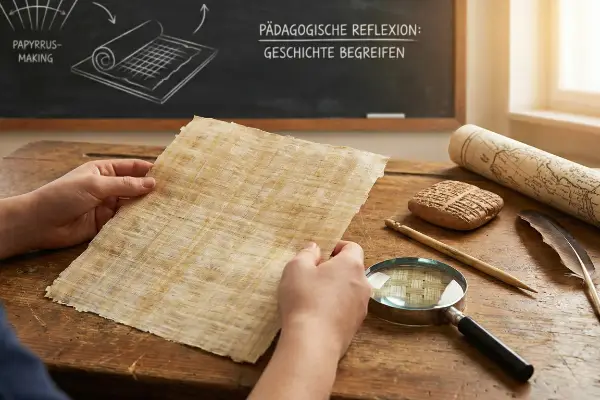
When students make papyrus themselves, something special happens. Not only does a creative product emerge, but a real connection develops between the learner and the process.
First, learning becomes multisensory. The material is seen, touched, pressed, and written on. History leaves the purely textual level and becomes physically tangible. This significantly increases attention and long-term retention.
Second, the history of technology becomes tangible in a completely new and wonderfully concrete way. The process shows that ancient cultures were not primitive precursors, but highly solution-oriented societies. The simple yet effective cross principle laid the foundation for administration, trade, and organization.
Third, the perspective widens from the object to the system. When students examine the production of papyrus for themselves, they begin to understand how essential the infrastructure behind writing materials really is. Without a writable material, lasting documentation is impossible. Without documentation, no complex state can exist.
That is exactly why this project is not just a craft lesson.
It is a shift in perspective that opens up entirely new ways of understanding.
Papyrus is more than a historical term – it is a key that opens our understanding of civilization.
Closing Image – The Quiet Rustling of Civilization
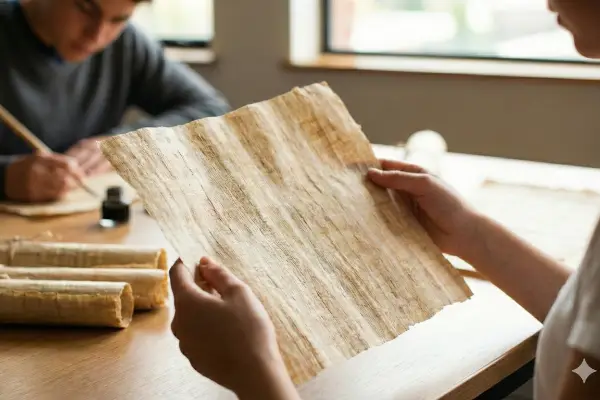
At the end of the lesson, it lies there. It is not a perfect industrial product. It does not have a flawless surface. It is a piece of papyrus made by hand. Perhaps slightly uneven. Perhaps gently wavy. But stable. And writable. Real.
One student runs a finger across the crossed fibers. Another tries to write with a reed pen along the structure and immediately notices that the direction matters. A soft rustling fills the room.
And that very sound is more than just the sound of a material.
It is an echo from the past.
Because anyone who has reconstructed the making of papyrus suddenly understands that writing is not made of signs alone. It needs a carrier. A material. A technical solution. And in ancient Egypt, that solution was just as crucial as roads, harbors, or storage facilities.
Tax lists were written on papyrus. Numbers of soldiers. Delivery contracts. Complaints about troublesome neighbors. Shopping lists. Love letters. Papyrus documents were not only a medium for great history, but also for everyday life.
In the dry regions of Egypt, papyrus documents have survived over a period of two thousand years. Not because they were intended to last forever, but because the climate preserved them. This environmental coincidence allows us direct insights into ancient life today.
When, at the end of the lesson, the self-made sheets are rolled up, a quiet parallel emerges. This is how texts were archived. This is how information was transported. This is how administration worked for centuries and millennia.
And perhaps, in the end, one insight remains that is greater than the project itself.
Civilization does not begin with monuments.
It begins with the ability to preserve information.
Anyone who holds papyrus is not holding a relic.
They are holding the foundation of organized societies in their hands.
And sometimes a soft rustling is enough to understand that.

FAQ on Production
Why should I make papyrus in the classroom?
Because it allows students not only to understand ancient writing culture in theory, but to reconstruct it in practice. The production principle makes the history of materials, technology, and state organization tangible and supports lasting learning.Is making papyrus historically meaningful or just a craft idea?
It is historically meaningful if the production principle is conveyed correctly. The crossed strips, pressing, and drying recreate the ancient technique in a model form and provide a well-founded introduction to writing culture.What historical added value does the project offer?
Students recognize that writing materials were a prerequisite for administration, trade, and the military. In ancient Egypt, papyrus was a strategically important material and a foundation of state organization.Is the amount of work realistic for classroom use?
Yes. The project can be integrated as a short, activity-based phase. Even a simplified model experiment is enough to make the production principle understandable.Which grade levels are suitable for making papyrus?
It is especially suitable for lower secondary education in the topic area of early civilizations. With a stronger focus on administration and statehood, the project can also be used in higher grades.Sources
- Papyrus (Lehrmaterial/Dokumentation); Klaus-Peter Schäffel; 2011; Eigenverlag.
- Das Buch in Antike, Mittelalter und Neuzeit; Jörg Graf; 2012; Harrassowitz.
- Papermaking, The History and Technique of an Ancient Art; Dard Hunter; 1978; Dover Publications.
- Cellulose (Beitrag: Papyrus production revisited); Florian Bausch, Mario J. Rosado, Jorge Rencoret et al.; 2022; Springer Nature.
Last update: March 6, 2026 – updated regularly