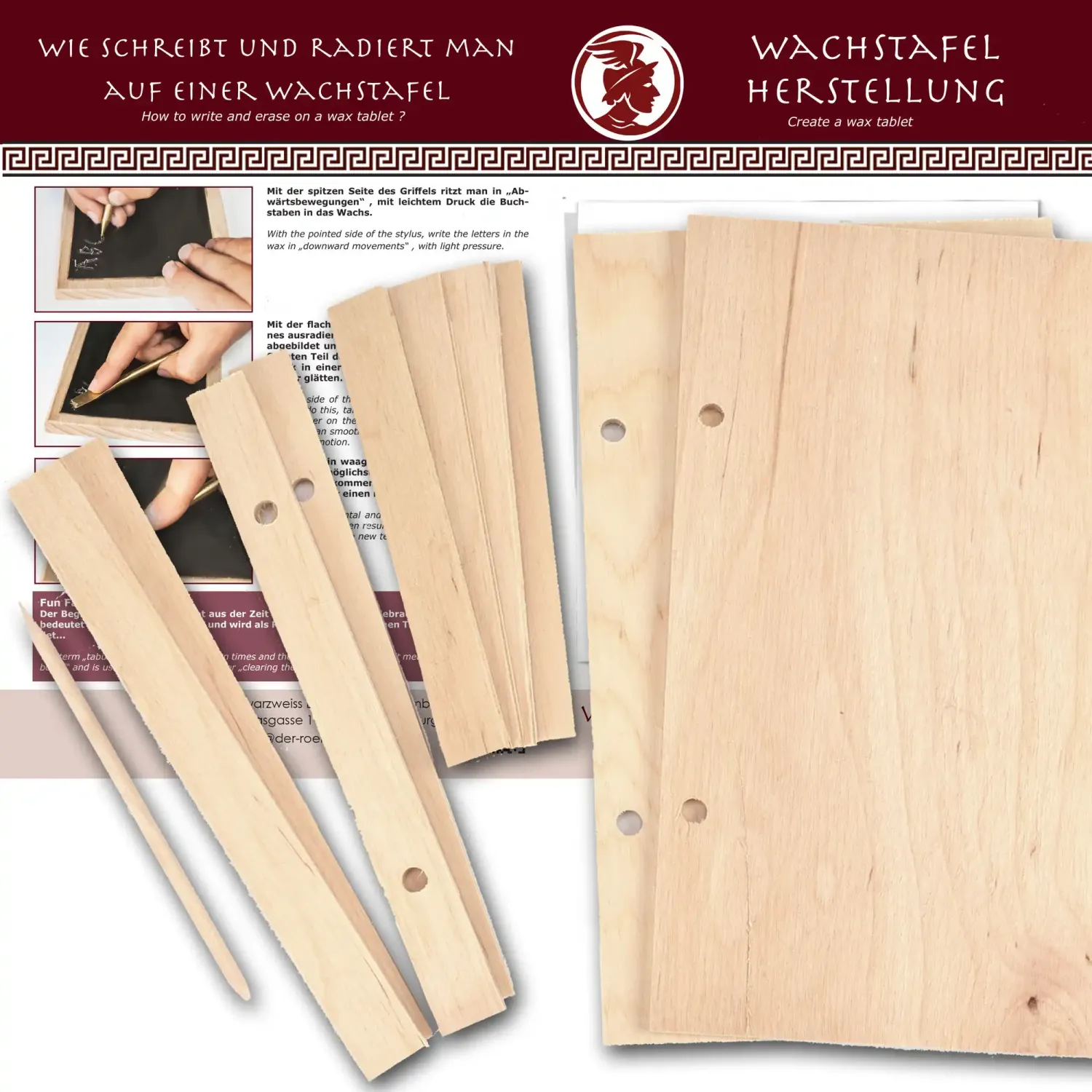
Old Red Wax Plates, Set of 5
The Red of Pompeii for Your Wax Tablet
The Old Red Wax Plates in a set of 5 are flexible wax plates measuring 20 × 10 cm, which You can use to refill wax tablets or equip self-made tablets for the first time. They are made from a paraffin-based wax mixture, remain supple with the warmth of the hand and do not break when cut to size. One plate fills one writing surface, in the colour tone of Pompeian wall painting.
When the Tablet Becomes an Eye-Catcher
Red Was the Colour of Importance in Rome
Anyone in antiquity who wanted to highlight something reached for red. The Romans knew two ways to get there. The simple one led through rubrica, red earth, inexpensive and available everywhere. The costly one led through minium, cinnabar, extracted mainly in Spanish Sisapo, today’s Almadén. The state controlled the trade, and the price was so high that cinnabar counted among the most precious pigments of the Roman world.
From rubrica comes a word we still use today. In Roman legal texts, headings were highlighted in red, and from these red titles came the word “rubric”. Every time a newspaper or form speaks of a rubric today, the red earth of antiquity is hidden inside it.
In Pompeii, red is everywhere. Entire rooms bear that deep, warm red which, under the name “Pompeian red”, still shapes wall paints, fabrics and furniture today. Old Red is exactly this tone: muted, earthy, closer to brick than to signal colour.
Red was not foreign to wax tablets either. Alongside the common black and uncoloured fillings, finds occasionally attest reddish writing wax, and at least one Roman poet complained at length about a red-coloured tablet. Anyone who gives their wax tablet Old Red today is therefore following a trace that can be tracked back to the Roman writing room.
Flexible, Colourfast, Quick to Use: the Old Red Wax Plates in Detail
The plates are made from a paraffin-based wax mixture. A proportion of microcrystalline wax keeps them elastic at room and hand temperature, so they can be bent and cut with scissors or a knife without breaking or splintering. The colour pigments are lightfast, so the Old Red remains strong even after years in the classroom.
Processing is quickly done: cut the plate to the size of the recess, warm it briefly between the palms of Your hands, insert it and press it down evenly with Your fingers. This keeps the surface smooth and unscratched. One layer is enough. One plate fills one writing surface, both for tablets measuring 14 × 9 cm and for the larger 19 × 11 cm tablets. The set of 5 is therefore enough for five single tablets or two double tablets plus one single tablet.
When writing, the script appears as a fine groove in the red base. How clearly it stands out depends on the writing pressure: if You press harder, the lighter wood underneath is exposed in places. An honest note on smoothing: because this is not pure beeswax, erasing with the flat end of the stylus requires a little more patience and a few more strokes. For heavily scratched surfaces, a trick from our event practice helps, only under adult supervision: briefly warm the flat end of a metal stylus in a candle flame, hold it by the cold end and then draw it across the wax surface. The surface melts slightly and becomes much easier to smooth. Always keep the tablet and wax plates at a distance from the flame. Anyone who writes and erases particularly often will find the natural beeswax plates the smoother alternative.
-
Contents: 5 wax plates per packaging unit
-
Dimensions: each 20 × 10 cm, thickness 0.5 mm
-
Material: paraffin-based wax mixture with microcrystalline wax, not pure beeswax
-
Colour: Old Red, lightfast pigments
-
Processing: cut to size, warm in the hand, press down with the fingers, one layer is enough
-
Yield: 1 plate per writing surface, suitable for tablets 14 × 9 cm and 19 × 11 cm
-
Use: refilling worn wax tablets, first filling of self-made tablets
The Red Tablet in Use: Classroom, Roman Festival and Craft Lesson
In the classroom, a red tablet makes a statement. In a class set of black or natural-coloured tablets, it becomes the teacher’s correction tablet, the tablet of the day for special tasks or the group colour during station work. The story of rubrica fits perfectly: anyone who tells the class that our word “rubric” comes from red earth and the red headings of Roman laws has the class’s attention immediately.
When building it Yourself, the plates show their flexibility. Children cut them to size, warm the plate in their hands and press it into the recess with their fingers without anything splintering. No stove, no hot wax, no breakage. Smaller hands also manage well with it.
At Roman festivals and at the museum stand, Old Red is an eye-catcher. A red tablet next to a black and a natural-coloured one shows at a glance that Roman writing wax knew more than one colour and provides an easy opening for a conversation about pigments, cinnabar and Pompeian red.
A small additional benefit: the wax mixture corresponds to the quality of decorative wax. Offcuts do not have to go in the bin, but can be used to decorate candles, for example as Roman letters or small ornaments.
The plates should be stored flat, cool and protected from light, not near radiators.
Who the Old Red Wax Plates Are Worthwhile For
When building and refilling with children, the Old Red plates show their strength. They remain flexible with the warmth of the hand, can be cut with scissors and do not splinter, even when small hands are still a little impatient.
In the class set, a red tablet next to black or natural-coloured tablets creates a clear accent: as the teacher’s correction tablet, as a group colour during station work or for special writing occasions. For several tablets, simply combine several packaging units, one plate per writing surface.
At Roman festivals and at the museum stand, Old Red shows at a glance that Roman writing wax was not only black. The visible contrast immediately provides a topic of conversation.
Red wax made from pure beeswax is created using beeswax pastilles and wax pigment, available in black and red. The pastilles are melted in a water bath, coloured with the pigment and poured directly into the recess. Pay attention to the quantity: the cooled wax should show a slight hollow. If it bulges above the edge, it was too much. This method takes longer, but produces a tablet made of real beeswax in the desired colour.
For daily use with frequent writing and erasing, the natural beeswax plates are better suited, as they can be smoothed more easily. The black wax plates Tabula Noctis offer the classic light-dark contrast of the most common Roman tablet.
Ovid and the Blood-Red Tablet
Ovid had sent his beloved a wax tablet with a request and received a rejection in return. Instead of looking for the fault in himself, he took aim at the tablet in his Amores. What particularly enraged him was its colour:
“At tamquam minio penitus medicata rubebas: / ille color vere sanguinulentus erat.”
“And yet You glowed red, as though soaked through and through with cinnabar: that colour was truly bloody.”
Ovid, Amores I, 12, lines 11–12, around 16 BC
For Ovid, the red was a bad omen; for archaeology, it is a stroke of luck. The lines prove that writing wax in Rome was coloured and that red played a role in it. Anyone who mentions minium means the expensive cinnabar red, the same pigment with which wealthy Pompeians likely had their walls painted.
Today, a red tablet is no longer a sign of misfortune. It is simply the tablet that stands out in the classroom. Whether the next message on it receives a yes has nothing to do with the colour.
Questions About the Old Red Wax Plates
Are the Old Red wax plates made of beeswax?
No. The plates are made from a paraffin-based wax mixture with a proportion of microcrystalline wax that keeps them flexible. They are coloured with lightfast pigments. Anyone who wants red wax made from pure beeswax melts beeswax pastilles in a water bath, colours them with red wax pigment and pours the tablet themselves.
How do I insert the plate correctly into the tablet?
Cut the plate to the size of the recess, warm it briefly between the palms of Your hands, insert it and press it down evenly with Your fingers. It is better not to use a spatula or the end of the stylus when inserting it, as both can leave scratches on the surface even before the first letter.
How do I smooth heavily scratched surfaces?
In everyday use, the flat end of the stylus is enough with a little patience and a few more strokes than with pure beeswax. For deep scratches, a trick helps, only under adult supervision: briefly warm the flat end of a metal stylus in a candle flame, hold it by the cold end and draw it across the surface. The wax melts slightly and becomes smooth again. Keep the tablet and plates at a distance from the flame while doing this.
Did red wax tablets really already exist among the Romans?
Yes. Alongside the common black and uncoloured fillings, finds occasionally attest reddish writing wax. The poet Ovid also describes in his Amores a tablet whose wax shone red as if coloured with cinnabar. Old Red takes up this colour tone.
What should I do with the offcuts?
The wax mixture corresponds to the quality of decorative wax. Leftovers can be used to decorate candles, for example as Roman letters, small ornaments or an SPQR on an Advent candle.
Pompeii’s Red Was Sometimes Yellow
“Pompeian red” is considered a hallmark of the ancient city. Part of it was originally not red at all. Studies by the Italian physicist Sergio Omarini from the National Institute of Optics in Florence showed in 2011 that some walls in Pompeii had once been painted with yellow ochre. The hot gases of the Vesuvius eruption in 79 AD chemically altered the pigment and turned the yellow into red.
So Pompeii is redder today than it was during the lifetime of its inhabitants. All the more reason to look more closely at the red: the deep, earthy Old Red of these wax plates is the tone we associate with Pompeii today, and Vesuvius played a major part in painting it.
Source: Sergio Omarini, Istituto Nazionale di Ottica (CNR), Florence, research results presented in 2011
Bibliography
Title: Amores (Love Poems)
Author: Ovid (Publius Ovidius Naso)
Publication: Tusculum edition, edited and translated by Niklas Holzberg, Artemis & Winkler, Munich/Zurich
Date: 1999 (original work around 16 BC)
Title: Naturalis Historia, Book XXXIII
Author: Pliny the Elder (Gaius Plinius Secundus Maior)
Publication: Tusculum edition, edited and translated by Roderich König, Artemis & Winkler, Munich/Zurich
Date: 1984 (original work around 77 AD)
Title: I colori pompeiani
Author: Selim Augusti
Publication: De Luca, Rome
Date: 1967
Title: Etymological Dictionary of the German Language, entry “Rubrik”
Author: Friedrich Kluge
Publication: De Gruyter, Berlin
Date: current edition
Further Links
Updated on: 14/10/2026
Forum Traiani ® | We make history understandable!